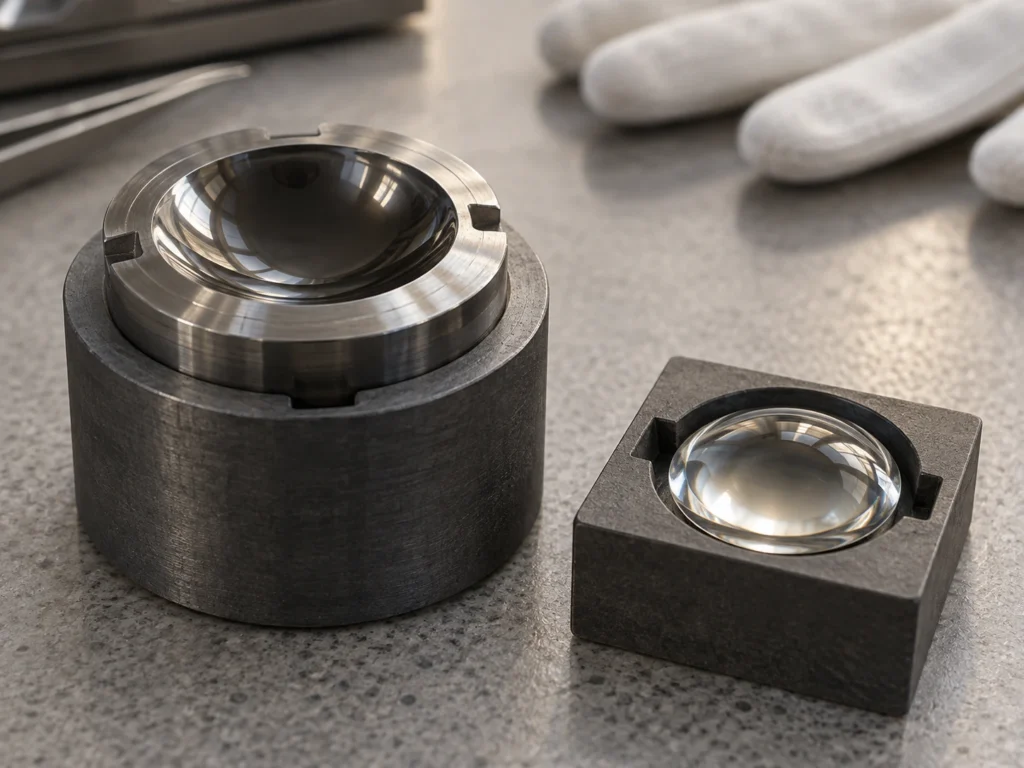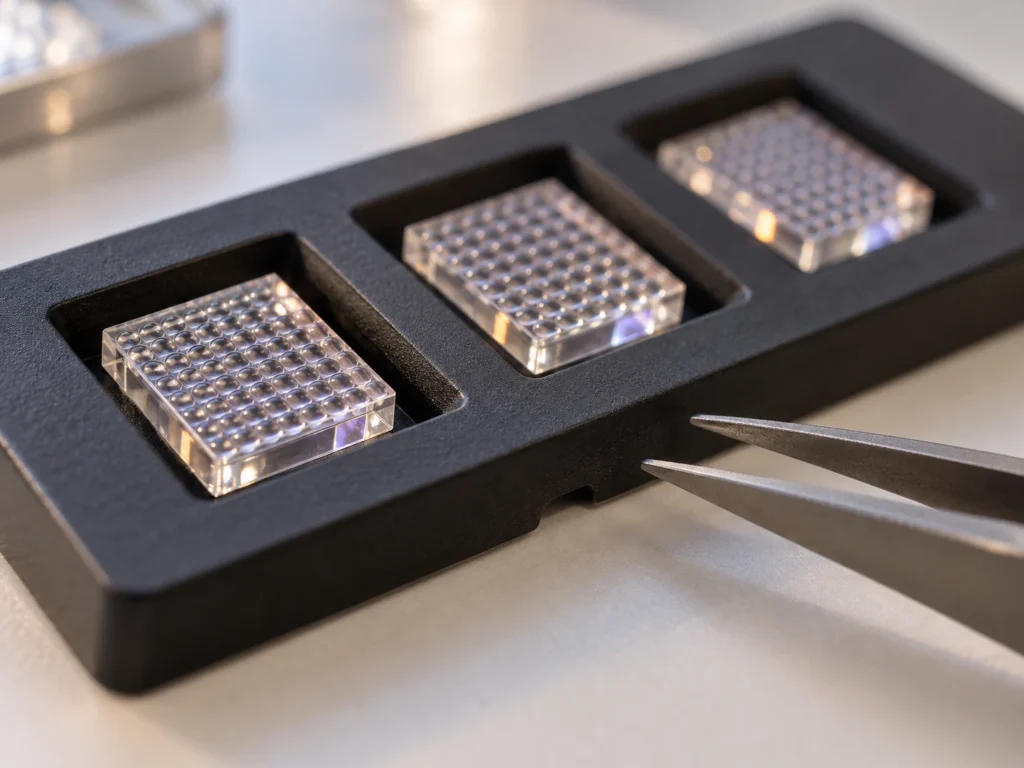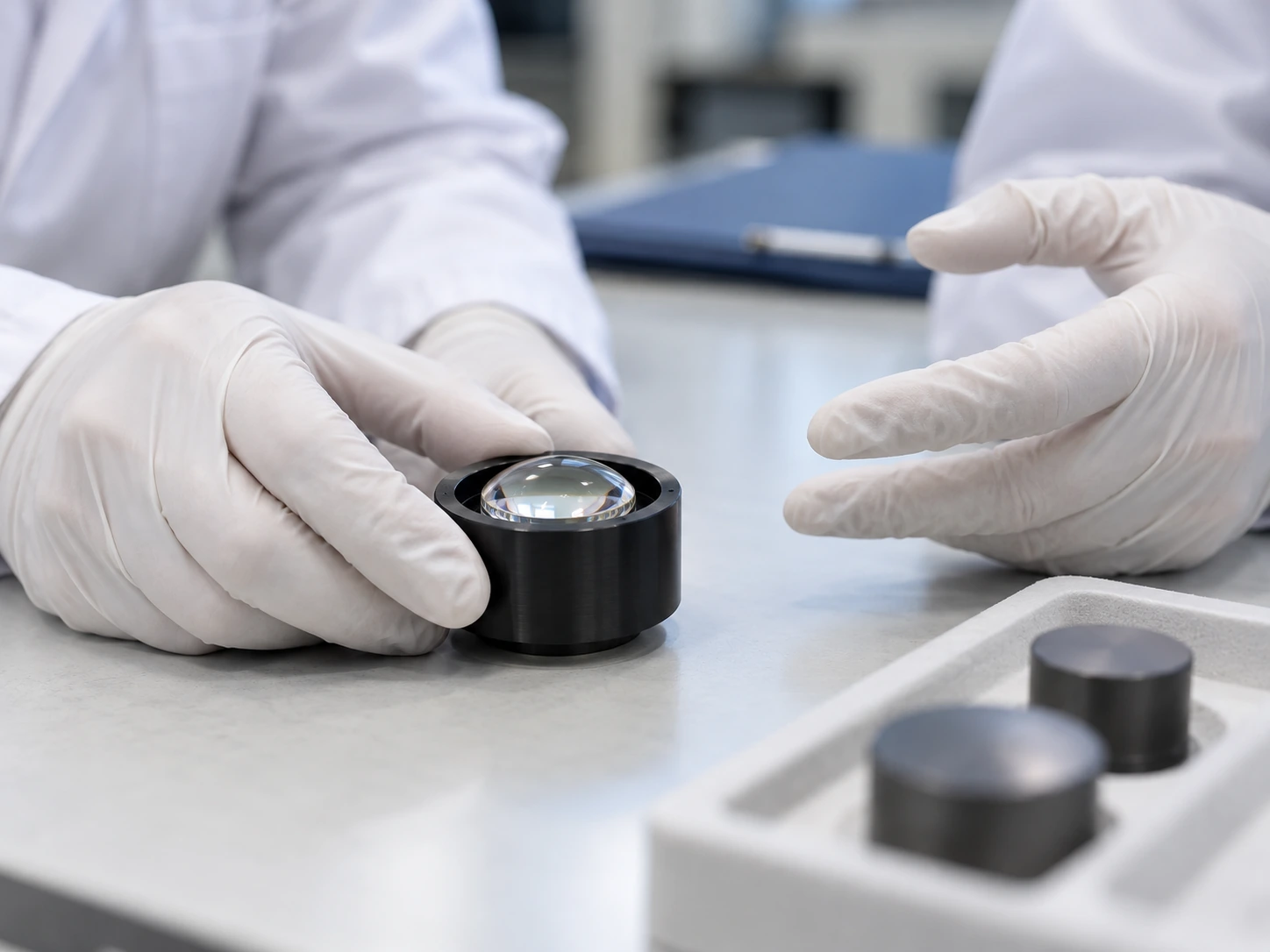
Aspherical glass lenses help optical designers achieve greater optical performance with fewer elements, supporting smaller and more compact imaging systems. Precision glass molding made these complex surfaces practical to reproduce at production volumes by pressing softened optical glass directly against a precision-engineered mold.
That manufacturing advantage places exceptional demands on the mold itself. Every lens is formed against the same high-value precision surface, making clean release, dimensional stability and mold durability fundamental to both lens quality and production economics.
How an Aspherical Glass Lens Is Pressed
Precision glass molding is a controlled high-temperature compression process. A glass preform is positioned between an upper and lower mold inside a protected process chamber, then heated until the glass becomes sufficiently deformable to replicate the mold geometry.
- PrepareThe glass preform and precision molds are loaded into a controlled chamber. Nitrogen, inert gas or vacuum is used to limit oxidation.
- HeatThe glass is heated above its glass-transition region into the molding window. Exact temperature depends on glass chemistry and can reach several hundred degrees Celsius.
- PressControlled force brings the molds together, transferring the precision aspherical geometry directly onto the softened glass surface.
- Cool & releaseThe lens is cooled under controlled conditions before the mold opens and the finished optic is separated from the tooling.
What the mold experiences in every cycle
Repeated thermal cycling, compression loading, direct contact with softened glass and chemical interaction at the glass–mold interface. As glass-transition temperature rises, the required molding window can move above 600°C, increasing the burden on both the mold material and its protective surface.
Why the Mold Surface Becomes a Production Cost
The mold carries the optical surface that is reproduced onto every lens. Precision aspherical molds are commonly produced from hard, thermally stable materials such as tungsten carbide and finished to extremely tight dimensional and surface tolerances. Protecting that master surface is therefore critical.
When softened glass begins to adhere to the mold, or when the surface oxidises and wears, the effect goes beyond a single rejected part. Sticking and residue can destabilise demolding, transfer defects onto the lens and shorten the interval before the tooling requires intervention.
- Sticking & residue
Release becomes less stable - Cleaning & servicing
Production is interrupted - Refurbish & recoat
Tooling requires restoration where feasible - Replace if necessary
Mold cost and lead time increase
The coating is not simply a protective layer. It helps determine how long a precision mold can remain productive before cleaning, refurbishment, recoating or replacement affects uptime and cost per lens.
Why Surface Protection Became Essential
The glass–mold interface needed to deliver three things at once: clean release, protection of the precision tool surface and stability under repeated high-temperature molding cycles. Different coating approaches addressed parts of that requirement, but each introduced its own trade-off.
Established high-temperature route
Pt-Ir Noble-Metal Coatings
Strong thermal and chemical stability made noble-metal systems an established solution for demanding precision glass molding conditions.
Carbon alternative
Conventional DLC
Low friction and anti-stick behaviour offered a carbon-based route without precious-metal dependency, but thermal and oxidative constraints increase as molding temperatures rise.
The opportunity was to retain the release and cost advantages of carbon while creating a harder, denser and more robust surface for precision glass lens molds.
Closing the Performance and Cost Gap
NTI Nanofilm developed TAC-ON®, a high-sp³, hydrogen-free tetrahedral amorphous carbon coating deposited using Filtered Cathodic Vacuum Arc technology. The dense ta-C structure combines ultra-high hardness with low friction, providing a more durable carbon surface without dependence on precious-metal coating materials for established molding conditions.
| Performance parameter | Pt-Ir noble metal | Conventional DLC | TAC-ON® ta-C |
|---|---|---|---|
| Hardness | ~1,200 HV* | ~1,500 HV | 3,000–5,000 HV |
| Coefficient of friction | ~0.60 | ~0.10–0.14 | ~0.10 COF |
| Molding temperature | ~700°C | <600°C | Up to 600°C** |
| sp³ carbon content | — | ~25% | Up to 88% |
| Indicative material cost | $$$$ | $ | $ |
| Indicative lifecycle cost | $$$$ | $$ | $ |
* Pt-Ir values are indicative and vary with alloy composition and coating architecture. ** Up to 600°C applies to the relevant TAC-ON® configuration on tungsten carbide. $ indicates relative cost burden for comparison only and does not represent quoted coating prices. Actual lifecycle economics depend on mold design, glass type, molding temperature, production volume and service interval.
Turning Surface Performance into Production Value
Applied as a thin functional surface, TAC-ON® helps protect the precision mold geometry while supporting cleaner separation between the molded glass and the tool. Its approximately 0.1 coefficient of friction reduces the tendency for sticking, while the high-sp³ structure provides substantially greater hardness than conventional DLC.
The production value is realised across the life of the tooling, not only in the coating itself.
- Longer mold utilisation
More production before cleaning or servicing - Fewer interventions
Reduced sticking-related maintenance and rework - Precision tooling protected
Preserves the value of high-cost mold surfaces - Lower material dependency
Reduces reliance on costly Pt-Ir coatings
TAC-ON® helped turn the mold surface from a recurring production constraint into an enabling interface for high-volume precision aspherical glass lens manufacturing.
The Next Generation of Optical Glass Is Raising the Temperature
The requirement is now evolving again. Optical applications increasingly demand glass materials selected for the performance of the finished system, including greater mechanical durability, chemical resistance, thermal stability, refractive performance and long-term dimensional stability.
These requirements are expanding the range of optical glasses manufacturers want to mold across advanced consumer electronics, imaging and higher-performance optical systems. Many of these materials require higher glass-transition and molding temperatures.
As temperature rises, oxidation, interdiffusion and chemical interaction between the glass, coating and mold accelerate. Carbon-based coatings also move progressively closer to their thermal and oxidative limits, particularly where residual oxygen in the molding environment cannot be completely eliminated.
The challenge is shifting from making the glass easier for the mold to process, to making the mold capable of processing the glass that the optical application requires.
Advancing Mold Protection for Higher-Temperature Glass
This higher-temperature operating regime is bringing renewed value to noble-metal materials because of their inherent thermal and chemical stability. The opportunity, however, is not simply to return to earlier coating approaches.
NTI Nanofilm is extending surface engineering toward next-generation noble-metal-based and hybrid coating architectures designed to combine high-temperature stability with engineered diffusion control, oxidation behaviour and release performance.
From high-sp³ ta-C for established precision glass molding to new surface architectures for more demanding optical materials, the objective remains the same: protect the precision mold, maintain clean glass release and keep advanced optics manufacturable at industrial scale.
Making the precision mold capable of processing the optical material that the application requires.