-
What is PECVD coating and how does it work?
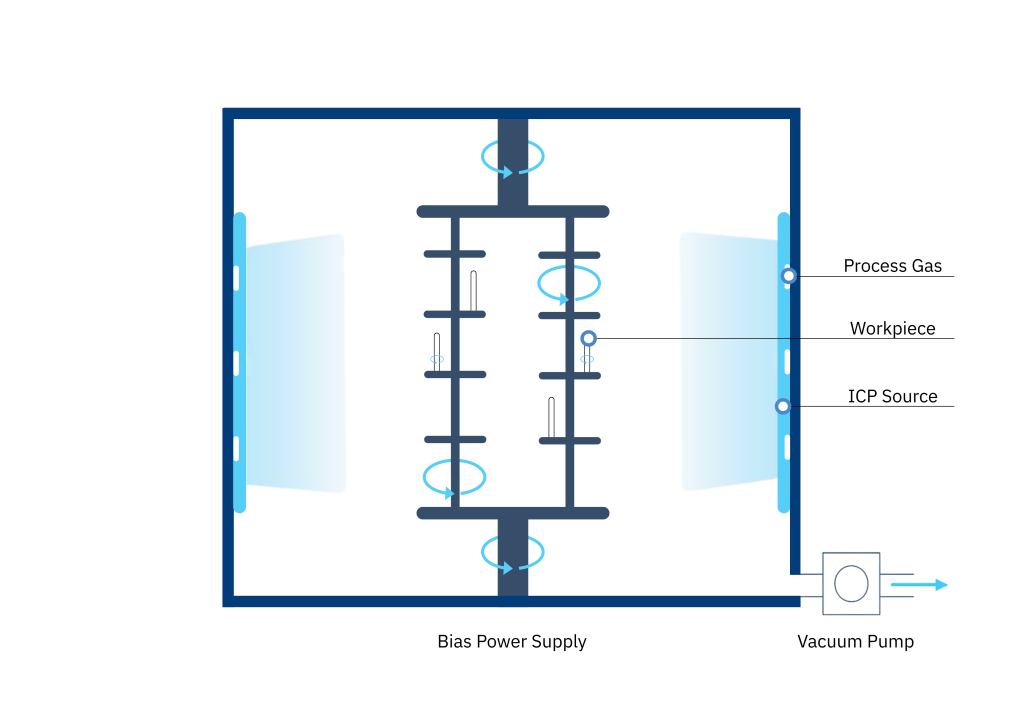
PECVD (plasma-enhanced chemical vapour deposition) is a thin-film coating process in which gaseous precursor compounds are introduced into a vacuum chamber and a plasma is used to activate those gases so they react and deposit a solid film on the substrate surface. Because the plasma replaces or reduces the need for high thermal energy, PECVD enables deposition at lower temperatures than traditional CVD. The result is a conformal, high-quality thin film that can coat complex geometries as the reactive species are generated in the gas phase and can reach sidewalls and 3D features.
-
What substrates and applications are suitable for PECVD coatings?
PECVD coatings are suited to a wide array of substrate types, metals, ceramics, polymers and composites, especially when the surface features are intricate, three-dimensional or porous. Key applications include optics and glass components (where uniform dielectric films matter), semiconductor parts (where conformality is critical), medical devices with complex structure, and porous substrates (such as filters or templates) that require protective or functional thin films. In each of these cases the strength of PECVD is in delivering uniform thickness, precise film chemistry and strong plasma bonding onto challenging surfaces.
-
What are the key performance benefits of PECVD coatings compared to other coating methods?
The major performance advantages of PECVD coatings include high film uniformity, tunable film properties, and excellent coverage on complex geometries and porous surfaces. Because the process uses plasma-activated gases, rather than simply depositing material from a solid target, the film composition, density, and stress can be finely controlled. The result is coatings that adhere strongly, perform consistently over large/irregular surfaces, and fulfil functional, optical, dielectric or protective roles. For products where surface performance must not vary across complicated structures, PECVD offers superior consistency and reliability.
-
How does PECVD improve coating quality and production efficiency?
PECVD improves both coating quality and production efficiency by combining low-temperature plasma activation with precise process control, enabling films to form uniformly across large areas and intricate shapes. The process produces coatings with excellent adhesion, high density, and precise chemical composition, even on heat-sensitive materials. Its ability to deposit films at lower temperatures reduces thermal stress and broadens the range of usable substrates, minimising rework and improving throughput. NTI Nanofilm PECVD systems also allow fine-tuning of gas chemistry, plasma power, and deposition rate, ensuring consistent results, stable film growth, and shorter production cycles. This translates into better surface performance, enhanced durability, and higher yield for industries such as optics, semiconductors, and advanced tooling.
-
How do I specify or evaluate a PECVD coating service for my application?
To specify a PECVD coating service effectively, you should start by clearly defining your substrate material and geometry, noting any temperature sensitivity or complex 3D/porous features. Then define the functional requirement of the coating, for example, whether you require a protective, dielectric, optical or decorative layer. Next, specify film thickness, uniformity tolerance, surface finish/aesthetic requirements, and any downstream conditions (e.g., exposure to chemicals, heat, mechanical load). Make sure the coating provider offers process control and quality assurance of plasma parameters (power, gas chemistry, biasing) and that their equipment is suited for your part size/volume. Because PECVD brings excellent conformity and lower temperature deposition, it can be a strong choice, but only if the specs and production environment are matched to its strengths.